March 23, 2026
The Dirty Truth About AI & Meaning
Like most people, I've been pondering the rise of AI. What does it mean for my future? How will it change society? Is it really as good as it seems?

The LORD God took the man and put him in the garden of Eden to work it and keep it.
Like most people, I've been pondering the rise of AI. What does it mean for my future? How will it change society? Is it really as good as it seems?
After working deeply with AI for the last few months, I find myself feeling insecure. I think most people are, and maybe someone needs to hear that. We're all processing the rapid shift from highly-skilled profession to automated intelligence in different ways. Some are in denial, others are doom scrolling themselves into oblivion, but everyone is effected.
Hard is Now Easy
As a software engineer, the connection and consequences of AI's emergence have been particularly personal. What used to be a very specialized skill is now automated to the level of at least a junior engineer (in my experience, this gap is quickly fading with newer models producing senior level work). Some have stated that AI will completely replace much of the workforce, not just in software but also in many informational and digital professions.
I find myself somewhat in the middle. I'm building an app solely with AI, and I can tell you that the hype is real. AI actually does an amazing job, especially with the models that have larger context windows like Opus 4.6 and GPT 5.4. However, it's not so good that you can tell it what you want, walk away for several hours, and come back to a fully tested and completed app. It's true that it can produce something close to that, but it can't do it well the first time and with complete product fit (then again, can a human?).
By nature of the context window limitations, it can't ingest the full scope of your app and code all at once, so it builds in scoped isolation that often times creates endless bug loops which need human intervention. That being said, it will not be long before this isn't an issue, and an app really will be able to be built from scratch with a thoroughly crafted system prompt.
For example, I built this very website in a little under 3 hours. I was working alongside Codex to build it, and I knew exactly what I wanted, but the speed and ease of creating a NextJS app with a local-only editor, email newsletter integration, and full mobile support was simple. Furthermore, while I enjoy designing, the previous limitations were removed as I let AI take my high-level direction and "run with it", so to speak. In the end, it built a great blog with a full post editor and taxonomy system that just worked.
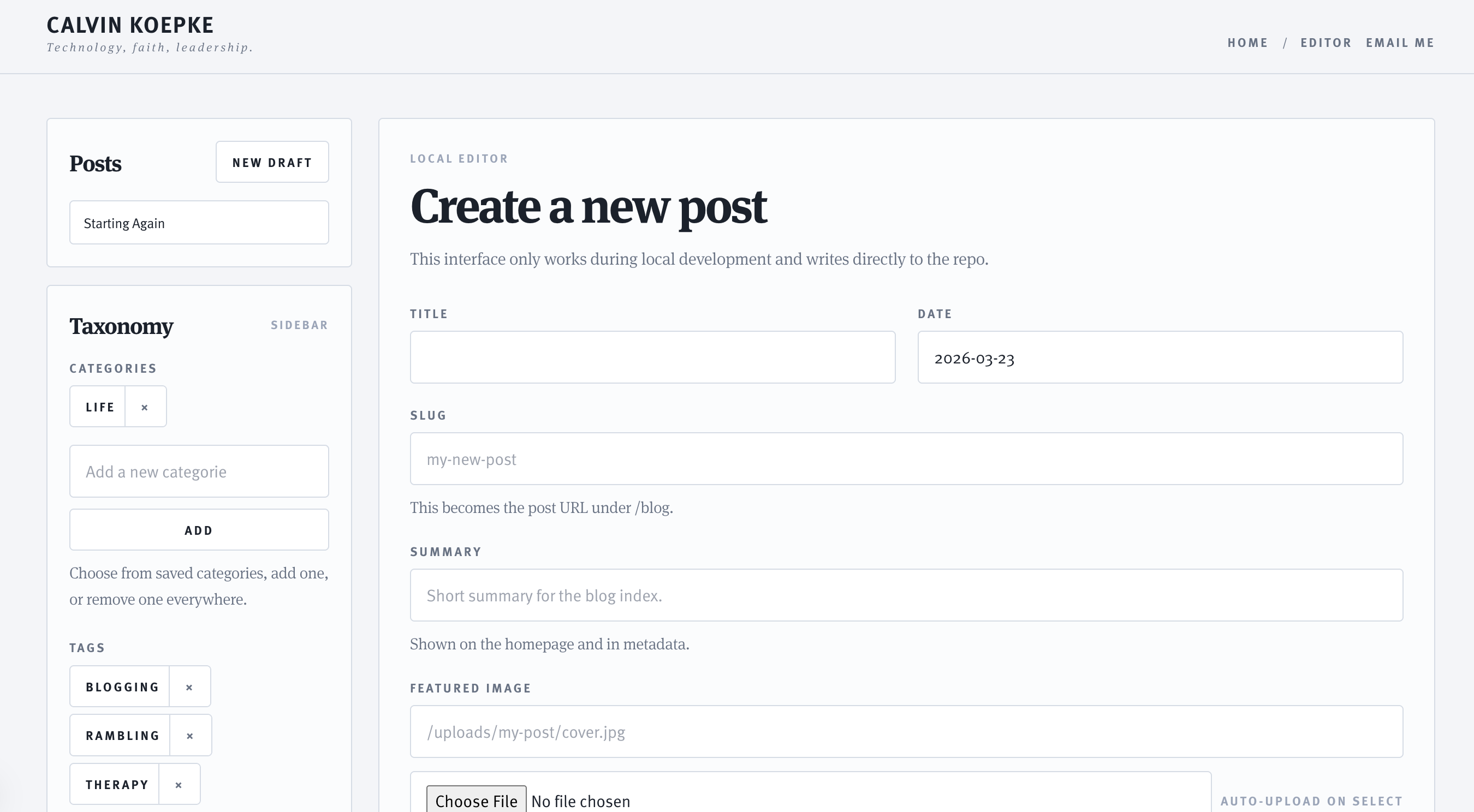
What is really important here, is that it built the platform according to my needs. I didn't get a generalized platform that provides features I'll never use. I didn't have to pay for any premium features (except $5/month for premium fonts). All of my integrations are free tier and free hosting. Infrastructure is cheap and output is even cheaper. For $20/month you can build a custom site of essentially any complexity and ship it in a fraction of the time it used to take.
Of course, there will always be people who don't want to work with a model. There will be room for products that build the guardrails and UX necessary for regular users to leverage AI — but the competition will be absolutely fierce, and the options for consumers will be as varied as the cereal aisle in a grocery store.
The Search for Meaning
In a world where "work" is often the basis for meaning, this becomes a little scary. Without getting too big in scope, let me talk about the engineering community. Our skillset has become commoditized. We don't want to admit it, but this is true. The value is no longer in our ability to write code, it's in our ability to guide and orchestrate AI in writing it. Even then, as models get better, they will begin to make better decisions when prompted with a business idea, and infrastructure and quality assurance guardrails will be built to ensure that deployments meet specified criteria.
In this world, writing code is a hobby, not a profession. Real value is derived from the idea that you ship, the part of you that spontaneously imagines a future that doesn't exist, and works to make that happen. If intelligence is automated, and physical labor next through robotics, what is left for humanity but connection, creativity, and emotion?
Of course there will be new jobs, but those jobs will look very different than before. Counseling, life coaching, caretaking, and community will become premium vocations in a world saturated with automation. The vast majority of content and informational output in the world will be AI generated, flooding the internet with words and pictures derived from a variety of datasets.
This is a world fundamentally worse than it is today. The promise of superpowers will advance it despite this, though, just like the digital age unlocked incredible advances in medicine and knowledge despite the devastating effects on our mental, emotional, and institutional health.
Once everything is run by AI (and it will be), many who are displaced, jobless, or overwhelmed will be looking for meaning and purpose. What will we do to come to their aid?
Working the Garden
In Genesis, God placed Adam in the garden of Eden. Not to simply enjoy it, but also to work and tend to it. To ensure that the growth was managed, the animals and plants were nourished, and that the place where man met with God was worthy of His presence.
While we may lose our jobs, or find them to be different than before (I am no economics expert, but I imagine that this will continue), we can rest assured that our primary purpose has never changed. It may be that what you thought you were meant to do was not in fact to ship code. It might have made you feel valuable at one point because of the paycheck it produced, or because of the status it placed on you in our hyper-connected culture, but these are all moving indicators of value and purpose.
The primary goal of the human life is to connect with God and with people. How we do that varies with everyone, and that is what makes it interesting. But I suppose, as I sit here and mentally process my place in this world, I am comforted that AI doesn't change any of that. It changes my circumstances, my future, and probably will eventually effect my job in a very real way.
But for now, I can breath the air, connect with my community and those around me, and trust God with the rest.
Subscribe
Get the full article in your inbox when something new is worth sending.